A Nova Scotia woman is the first person in Atlantic Canada to have a special procedure called AngioVac to treat a blood infection near her heart, rather than open-heart surgery. Full story via CBC.

New interventional radiology suites allow medical experts to treat some diseases without major surgery.

The Canadian Association for Interventional Radiology (CAIR) will be holding a virtual Annual General Meeting (AGM) for its voting members in good standing on June 14th, 2021 at 7:00 pm EST.

The Canadian Association for Interventional Radiology (CAIR) will be holding a virtual Annual General Meeting (AGM) for its voting members in good standing on June 14th, 2021 at 7:00 pm EST.

CAIR Express - your Canadian Interventional Radiology newsletter at your fingertips. Feel free to pass it along to others in your network, and most importantly, enjoy the content that is developed with you in mind. 

The Department of Radiology at Niagara Health seeks a highly skilled and motivated fellowship trained Vascular and Interventional Radiologist with a track record for providing compassionate and efficient care to join the Diagnostic Imaging Service.

Interventional radiology is a field that offers boundless opportunities and part of what makes this specialty one of the most exciting fields in medicine is the fact that it is constantly evolving.

Tara Utley has over 20 years of experience in the medical imaging industry between the clinical environment as an Interventional Technologist (MRT), and delivering education through her more recent experiences in product management.

With the introduction of the Royal College (RC) Subspecialty exam in Interventional Radiology (IR), practicing IRs across Canada are faced with a decision: Do I really need to take another Royal College exam? 

This segment will feature a unique pearl learned by a junior VIR staff during residency or fellowship to share with our community.

Dr. Woodley-Cook has been practicing diagnostic and interventional radiology in Scarborough since 2015, where he has honed his practice to emphasize on hemodialysis interventions and peripheral vascular disease.

ANNUAL GENERAL MEETING OF MEMBERS

ASSEMBLÉE GÉNÉRALE DES MEMBRES


Via Zoom

Date: June 14th, 2021

Time : 7:00pm EST


Agenda/ Ordre du Jour

1 .Welcome from the President / Mot de bienvenue de la Présidente – Dr. Amol Mujoomdar 

  • Testing voting system/ Vérification système de votes
  • Call to order and confirmation of quorum/Confirmer le quorum

2. Approval of the Agenda / Adoption de l’ordre du jour – Dr. Amol Mujoomdar

3. Highlights of 2020 / Faits marquants de 2020  – Dr. Amol Mujoomdar

4. Report from the Secretary-Treasurer / Rapport du secrétaire-trésorier Dr. Darren Klass

  • Approval of CAIR Financial Review / Adoption des états financiers de CAIR
  • Approval of Waiving of an Audit / Adoption de la renonciation à un audit

 5. Presentation of the New Board Officers / Présentation des nouveaux dirigeants du conseil d’administration Dr. Amol Mujoomdar

President/Président: Dr. Tara Graham
Past-President/Président sortant: Dr. Amol Mujoomdar
Vice-President/Vice-Président: Dr Alessandra Cassano-Bailey
Secretary-Treasurer/secretaire-trésorier: Dr. David Valenti

 6. Adjournment of Meeting / Ajournement de l’assemblée – Dr. Amol Mujoomdar


New interventional radiology suites allow medical experts to treat some diseases without major surgery.

The Canadian Association for Interventional Radiology (CAIR) will be holding a virtual Annual General Meeting (AGM) for its voting members in good standing on June 14th, 2021 at 7:00 pm EST.

The Canadian Association for Interventional Radiology (CAIR) will be holding a virtual Annual General Meeting (AGM) for its voting members in good standing on June 14th, 2021 at 7:00 pm EST.

CAIR Express - your Canadian Interventional Radiology newsletter at your fingertips. Feel free to pass it along to others in your network, and most importantly, enjoy the content that is developed with you in mind. 

The Department of Radiology at Niagara Health seeks a highly skilled and motivated fellowship trained Vascular and Interventional Radiologist with a track record for providing compassionate and efficient care to join the Diagnostic Imaging Service.

Interventional radiology is a field that offers boundless opportunities and part of what makes this specialty one of the most exciting fields in medicine is the fact that it is constantly evolving.

Tara Utley has over 20 years of experience in the medical imaging industry between the clinical environment as an Interventional Technologist (MRT), and delivering education through her more recent experiences in product management.

With the introduction of the Royal College (RC) Subspecialty exam in Interventional Radiology (IR), practicing IRs across Canada are faced with a decision: Do I really need to take another Royal College exam? 

This segment will feature a unique pearl learned by a junior VIR staff during residency or fellowship to share with our community.

Dr. Woodley-Cook has been practicing diagnostic and interventional radiology in Scarborough since 2015, where he has honed his practice to emphasize on hemodialysis interventions and peripheral vascular disease.

Annual general Meeting 2021

Canadian Association for Interventional Radiology

The Canadian Association for Interventional Radiology (CAIR) will be holding a virtual Annual General Meeting (AGM) for its voting members in good standing on June 14th, 2021 at 7:00 pm EST.

Registration is required for this meeting

To ensure that we are able to discuss and vote on motions at the AGM, we require registration for all members in advance of the AGM.

To register please use the following link.

Once you have completed registration, you will receive full access details for our Zoom based AGM.


AGM documents

Agenda

The agenda for this year’s AGM has been modified to fit the online format. You can find the full agenda here. – coming soon

2020 Annual Report

The 2020 CAIR annual report is available for download here.

2020 Financial Statements

The 2020 Financial Statements for CAIR are available for review here.

Board of Directors

This year, a new President, Vice-President, and Treasurer will be appointed to the Board of Directors.  You will find the status of the 2020 Board of Directors, including the newly appointed officers here. – coming soon

We look forward to seeing you online!

For questions and inquiries about our AGM, please contact Siri Boulom

New interventional radiology suites allow medical experts to treat some diseases without major surgery.

The Canadian Association for Interventional Radiology (CAIR) will be holding a virtual Annual General Meeting (AGM) for its voting members in good standing on June 14th, 2021 at 7:00 pm EST.

The Canadian Association for Interventional Radiology (CAIR) will be holding a virtual Annual General Meeting (AGM) for its voting members in good standing on June 14th, 2021 at 7:00 pm EST.

CAIR Express - your Canadian Interventional Radiology newsletter at your fingertips. Feel free to pass it along to others in your network, and most importantly, enjoy the content that is developed with you in mind. 

The Department of Radiology at Niagara Health seeks a highly skilled and motivated fellowship trained Vascular and Interventional Radiologist with a track record for providing compassionate and efficient care to join the Diagnostic Imaging Service.

Interventional radiology is a field that offers boundless opportunities and part of what makes this specialty one of the most exciting fields in medicine is the fact that it is constantly evolving.

Tara Utley has over 20 years of experience in the medical imaging industry between the clinical environment as an Interventional Technologist (MRT), and delivering education through her more recent experiences in product management.

With the introduction of the Royal College (RC) Subspecialty exam in Interventional Radiology (IR), practicing IRs across Canada are faced with a decision: Do I really need to take another Royal College exam? 

This segment will feature a unique pearl learned by a junior VIR staff during residency or fellowship to share with our community.

Dr. Woodley-Cook has been practicing diagnostic and interventional radiology in Scarborough since 2015, where he has honed his practice to emphasize on hemodialysis interventions and peripheral vascular disease.

CAIR Express – your Canadian Interventional Radiology newsletter at your fingertips. Feel free to pass it along to others in your network, and most importantly, enjoy the content that is developed with you in mind.

New interventional radiology suites allow medical experts to treat some diseases without major surgery.

The Canadian Association for Interventional Radiology (CAIR) will be holding a virtual Annual General Meeting (AGM) for its voting members in good standing on June 14th, 2021 at 7:00 pm EST.

The Canadian Association for Interventional Radiology (CAIR) will be holding a virtual Annual General Meeting (AGM) for its voting members in good standing on June 14th, 2021 at 7:00 pm EST.

CAIR Express - your Canadian Interventional Radiology newsletter at your fingertips. Feel free to pass it along to others in your network, and most importantly, enjoy the content that is developed with you in mind. 

The Department of Radiology at Niagara Health seeks a highly skilled and motivated fellowship trained Vascular and Interventional Radiologist with a track record for providing compassionate and efficient care to join the Diagnostic Imaging Service.

Interventional radiology is a field that offers boundless opportunities and part of what makes this specialty one of the most exciting fields in medicine is the fact that it is constantly evolving.

Tara Utley has over 20 years of experience in the medical imaging industry between the clinical environment as an Interventional Technologist (MRT), and delivering education through her more recent experiences in product management.

With the introduction of the Royal College (RC) Subspecialty exam in Interventional Radiology (IR), practicing IRs across Canada are faced with a decision: Do I really need to take another Royal College exam? 

This segment will feature a unique pearl learned by a junior VIR staff during residency or fellowship to share with our community.

Dr. Woodley-Cook has been practicing diagnostic and interventional radiology in Scarborough since 2015, where he has honed his practice to emphasize on hemodialysis interventions and peripheral vascular disease.

The Department of Radiology at Niagara Health seeks a highly skilled and motivated fellowship trained Vascular and Interventional Radiologist with a track record for providing compassionate and efficient care to join the Diagnostic Imaging Service. The candidate will be a member of a 24/7 full service interventional radiology program for the Niagara Region.

Niagara Health is one of the largest multi-site health care systems in Ontario serving 434,000 residents within the Regional Municipality of Niagara. With 700 beds, 4,500 employees, 640 physicians and a $500M budget, the NHS provides a wide range of inpatient and outpatient services across six sites encompassing operations in Fort Erie, Niagara Falls, Niagara-on-the-Lake, Port Colborne, Welland and a one million square foot state-of-the-art hospital in St. Catharines.

The transformation of healthcare service delivery across Niagara continues with planning underway to build an additional ultramodern hospital in South Niagara Falls to provide accessible and quality healthcare to residents of the Southern Region. Niagara Health is positioned, by virtue of its geography and regionally distributed resources, to exemplify the best of regional capacity with local service delivery. Strong academic partnerships are a priority for the NH as the organization builds on a robust relationship with McMaster University’s Michael G. DeGroote School of Medicine.

Current group

  • Twenty radiologist group
  • Interventional radiology call is shared equally with 1:4 frequency

The Practice

  • The successful candidate is expected to participate fully in a co-operative way with the other members encompassing all image guided interventional procedures included vascular access, arterial, hepatobiliary, and genitourinary interventions including a strong interventional oncology program with tumor ablation and TACE.
  • The candidate is expected to participate in other diagnostic imaging rotations including fluoroscopy, ultrasound, CT, x-ray and MRI.

Academic Affiliations

The McMaster University’s Michael G. DeGroote School of Medicine has expanded to a regional campus in Niagara, which is located at Brock University. Students at the Niagara Regional Campus complete their clinical rotations in one of the six area hospitals with teaching done by the highly skilled and motivated hospital physicians.
Opportunities for strengthening and building strong academic partnerships are a priority for Niagara Health
We are interested in Physicians who will pursue a university faculty appointment and participate in academic activities within a strong regional community hospital setting.

Tertiary Care

  • St. Joseph’s Hospital Hamilton and Hamilton Health Sciences < 1 hour away

Qualifications Required

The successful applicant must:

  • Have or be eligible for Independent CPSO License
  • Fellowship training in all aspects of vascular and non-vascular interventional radiology and interventional oncology
  • Strong interpretive skills in all imaging modalities including CT, MRI, Ultrasound and X-Ray
  • Excellent clinical skills are a prerequisite for this high volume department
  • Must have a strong interest and/or existing background in clinical/academic radiology
  • Be eligible for academic appointment
  • Hold valid OHIP billing number and have billing privileges

Closing Date: May 28, 2021

Contact

Medical Affairs Office
Niagara Health
905-378-4647 Ext. 44224
Medicalaffairs@niagarahealth.on.ca

On behalf of:
Dr. Amit Mehta
Deputy Chief of Diagnostic Imaging
Niagara Health

New interventional radiology suites allow medical experts to treat some diseases without major surgery.

The Canadian Association for Interventional Radiology (CAIR) will be holding a virtual Annual General Meeting (AGM) for its voting members in good standing on June 14th, 2021 at 7:00 pm EST.

The Canadian Association for Interventional Radiology (CAIR) will be holding a virtual Annual General Meeting (AGM) for its voting members in good standing on June 14th, 2021 at 7:00 pm EST.

CAIR Express - your Canadian Interventional Radiology newsletter at your fingertips. Feel free to pass it along to others in your network, and most importantly, enjoy the content that is developed with you in mind. 

The Department of Radiology at Niagara Health seeks a highly skilled and motivated fellowship trained Vascular and Interventional Radiologist with a track record for providing compassionate and efficient care to join the Diagnostic Imaging Service.

Interventional radiology is a field that offers boundless opportunities and part of what makes this specialty one of the most exciting fields in medicine is the fact that it is constantly evolving.

Tara Utley has over 20 years of experience in the medical imaging industry between the clinical environment as an Interventional Technologist (MRT), and delivering education through her more recent experiences in product management.

With the introduction of the Royal College (RC) Subspecialty exam in Interventional Radiology (IR), practicing IRs across Canada are faced with a decision: Do I really need to take another Royal College exam? 

This segment will feature a unique pearl learned by a junior VIR staff during residency or fellowship to share with our community.

Dr. Woodley-Cook has been practicing diagnostic and interventional radiology in Scarborough since 2015, where he has honed his practice to emphasize on hemodialysis interventions and peripheral vascular disease.

Mary Jiayi Tao MD, PGY4 Diagnostic Radiology, University of Toronto

Mary Jiayi Tao MD, PGY4 Diagnostic Radiology, University of Toronto

What you did in residency (and/or medical school) to help with your decision?

There were several factors that helped me solidify my desire to become an interventional radiologist.

  • Early exposure: I got involved in a research project in interventional radiology during my first year of medical school. In doing so, I had the opportunity to shadow and spend time in the interventional radiology department which was incredibly exciting and eye-opening. Once I got into residency, I knew I wanted to explore interventional radiology as a potential fellowship based on my prior exposures, so I organized rotations in IR earlier in my training (starting in my PGY2 year) and did shadow shifts to help me make an informed decision. I never turned back after my first week.
  • Conferences: I had opportunities to attend some IR conferences over the course of medical school and residency training which helped me learn more about the types of innovating procedures and the cutting-edge research in interventional radiology. It really makes you excited for what is to come in the specialty.
  • Mentorship: Having mentors who guide, support, and challenge you is immensely important. I have been very fortunate to have worked alongside many talented and distinguished interventional radiologists over the course of my training thus far. Their unwavering dedication to mentorship has helped me every step of the way.

 How was the application process?

It was an exciting and nerve-wrecking process especially this year given that the application happened during the beginning stages of the COVID-19 pandemic which added to the degree of uncertainty. Deadlines and requirements for fellowships vary program to program so was it critical to stay organized, prepare documentations in advance and to follow-up with the application to ensure its completion. This year, all fellowship interviews were conducted virtually which had its advantages and disadvantages. Obviously, I would have loved to travel to the individual programs to see the facilities/cities and to meet the interviewers in-person, but virtual interviews were very time-efficient and cost-effective.

What do you look forward to as a fellow?

I am looking forward to being constantly challenged and absorbing as much knowledge and skills over the course of my fellowship year.

 What excites you about VIR?

Interventional radiology is a field that offers boundless opportunities and part of what makes this specialty one of the most exciting fields in medicine is the fact that it is constantly evolving. A lot of the procedures performed nowadays did not even exist 10-15 years ago! The breadth of pathologies and management strategies is incredible and ever-expanding so I know that my curiosity will always be stimulated in this specialty.


New interventional radiology suites allow medical experts to treat some diseases without major surgery.

The Canadian Association for Interventional Radiology (CAIR) will be holding a virtual Annual General Meeting (AGM) for its voting members in good standing on June 14th, 2021 at 7:00 pm EST.

The Canadian Association for Interventional Radiology (CAIR) will be holding a virtual Annual General Meeting (AGM) for its voting members in good standing on June 14th, 2021 at 7:00 pm EST.

CAIR Express - your Canadian Interventional Radiology newsletter at your fingertips. Feel free to pass it along to others in your network, and most importantly, enjoy the content that is developed with you in mind. 

The Department of Radiology at Niagara Health seeks a highly skilled and motivated fellowship trained Vascular and Interventional Radiologist with a track record for providing compassionate and efficient care to join the Diagnostic Imaging Service.

Interventional radiology is a field that offers boundless opportunities and part of what makes this specialty one of the most exciting fields in medicine is the fact that it is constantly evolving.

Tara Utley has over 20 years of experience in the medical imaging industry between the clinical environment as an Interventional Technologist (MRT), and delivering education through her more recent experiences in product management.

With the introduction of the Royal College (RC) Subspecialty exam in Interventional Radiology (IR), practicing IRs across Canada are faced with a decision: Do I really need to take another Royal College exam? 

This segment will feature a unique pearl learned by a junior VIR staff during residency or fellowship to share with our community.

Dr. Woodley-Cook has been practicing diagnostic and interventional radiology in Scarborough since 2015, where he has honed his practice to emphasize on hemodialysis interventions and peripheral vascular disease.

Tara Utley, Senior Product Manager X-ray/Vascular, Canon Medical Systems Canada

Tara Utley, Senior Product Manager X-ray/Vascular, Canon Medical Systems Canada

Tara Utley has over 20 years of experience in the medical imaging industry between the clinical environment as an Interventional Technologist (MRT), and delivering education through her more recent experiences in product management. She started with Canon Medical Systems Canada (formerly Toshiba) in 2010 as a Clinical Applications Specialist and spent 7 years with Canon Medical Systems USA leading the Interventional Training Programs and Product Management teams in Tustin, California. As of September 2020, she commenced her current role at Canon Medical Systems Canada headquarters based out of Markham, Ontario.


What are you most excited about at Canon Medical?

I am always excited about our innovation and dedication to further develop and perfect current advanced software and hardware to improve workflow and patient outcomes. Our Alphenix 4D CT system has just been Health Canada approved and is a great example. The Canon Alphenix 4D CT seamlessly integrates our most flexible Alphenix Interventional system with our advanced Aquilion ONE Genesis CT system into one versatile, high-performance solution. The combination of a functional interventional lab with a complete CT imaging suite provides a streamlined workflow with one of the key outcomes being the patient no longer needs to be transferred between departments. With the ability to diagnose, plan, treat and verify in the same room, the Alphenix 4D CT helps Interventional Radiologists prioritize safety, speed, and efficiency during the most complex interventions.

Are there any new technologies in the works at Canon Medical that you would like our readers to know about?

Yes, our new 30cm x 40cm (12” x 16”) High Definition Detector for Interventional Radiology.

In 2018, Canon Medical Systems released the world’s first High-Definition Detector. A true two-in-one detector providing more than 2x higher spatial resolution compared to conventional detectors. The Hi-Def detector is equipped with the standard imaging field of views (FOV), but also three additional Hi-Def FOV modes, which provide the Interventionalist with visibility never seen before. Surgeons have been using microscopes in the operating room for decades, now the Interventionalist can in their labs too. This technology provides a high degree of certainty during difficult interventions, which in turn increases efficiency and improves workflow. As efficiency and certainty of device placement and/or treatment improves, the need for additional advanced imaging decreases and as a result, dose and exposure to the patient and operator does too.

For the initial launch in 2018, the High Definition Detector was introduced with our 30cm x 30cm (12” x 12”) Flat Panel Detector (FPD) on our Core+ floor-mounted c-arm. With its success and over 50 global installations, we are very excited to announce the High Definition Detector is now being released with our 30cm x 40cm (12” x 16”) Sky+ ceiling-mounted c-arm. We expect to receive Health Canada approval in the summer of 2021.

What kinds of partnerships do you foresee between front-line interventional radiologists/IR teams and the industry in the future?

Partnerships and supporting our front-line Interventional Radiologists, Technologists, and the overall industry is now more important than ever. Canon Medical Systems Canada is a proud sponsor of the CAIR association. The need to make Interventional Radiology treatments widely accessible to Canadian patients is an endeavor we share. Through our combined focus on education, coupled with the products and solutions Canon Medical develops; together we will provide better patient care for Canadians. In addition, Canon Medical is collaborating with global customers to create a peer-to-peer expert forum for both the Alphenix 4D CT and the new High Definition Detector. This sharing of best practices will further advance the development of Interventional Radiology around the globe.

If an interventional radiologist had an idea for new devices or technology, what would be the first steps to seeing it developed?

At Canon Medical Systems Corporation, our Vascular Business Unit directly manages complete product life cycles from development to installation, production, and support. In the case of the Canadian team, our Application, Clinical, and Services support teams listen to our frontline customers and report on the feedback they obtain from the field. This information is communicated to the engineers who in turn apply during the development and refinement of our products and technology. Moreover, in addition to Japan playing a central role, we have established development centers in North America, Europe, and Asia, making it possible to conduct research and development activities that leverage expertise across the globe. With the goal to revolutionize technology and to create value, we are proactively involved in collaborative research with many Interventional Radiologists, advanced medical institutions, and universities.

I understand that prior to transitioning to the business side of Interventional Radiology; you were an Interventional Technologist at the Hospital for Sick Children. What has been the biggest change you have seen in the field of Interventional?

For me, I think the biggest change has been the increased focus and dedication to dose management. When I was working as an Interventional Technologist, I was always very cautious of dose. Then the Image Gently and Image Wisely campaigns were launched and I became even more aware. At Canon Medical, low-dose imaging has always been a priority. All of our systems utilize dose-saving technology to provide advanced dose reduction, dose management techniques, and tools to benefit clinical staff, medical facility administrators, and patients. For example, the DoseRite DTS (Dose Tracking System) provides a real-time display that tracks cumulative skin dose distribution, as well as peak skin dose, to the patient. This technology helps to avoid the potential risk of radiation injury. It also prompts the operator to fan the beam, collimate, reduce the PPS, store fluoro loops and use Live Zoom. Another example of our DoseRite Technology is Spot Fluoroscopy. Spot Fluoro is like having an adjustable spotlight over the reference LIH image, allowing the clinician to select and view the critical region of interest live and have the surrounding area visible for reference, all without exposing the area outside the critical region.


*This content was created by CAIR editors on behalf of Canon Medical as a CAIR industry partners.  CAIR makes no claims, promises, or guarantees about the accuracy, completeness, or adequacy of the content, and expressly disclaims liability for errors and omissions in the contents of this article. Reference to any specific commercial product, process, or service, or the use of any trade, firm or corporation name is for the information and convenience of the public, and does not constitute endorsement, recommendation, or favoring by the CAIR.

New interventional radiology suites allow medical experts to treat some diseases without major surgery.

The Canadian Association for Interventional Radiology (CAIR) will be holding a virtual Annual General Meeting (AGM) for its voting members in good standing on June 14th, 2021 at 7:00 pm EST.

The Canadian Association for Interventional Radiology (CAIR) will be holding a virtual Annual General Meeting (AGM) for its voting members in good standing on June 14th, 2021 at 7:00 pm EST.

CAIR Express - your Canadian Interventional Radiology newsletter at your fingertips. Feel free to pass it along to others in your network, and most importantly, enjoy the content that is developed with you in mind. 

The Department of Radiology at Niagara Health seeks a highly skilled and motivated fellowship trained Vascular and Interventional Radiologist with a track record for providing compassionate and efficient care to join the Diagnostic Imaging Service.

Interventional radiology is a field that offers boundless opportunities and part of what makes this specialty one of the most exciting fields in medicine is the fact that it is constantly evolving.

Tara Utley has over 20 years of experience in the medical imaging industry between the clinical environment as an Interventional Technologist (MRT), and delivering education through her more recent experiences in product management.

With the introduction of the Royal College (RC) Subspecialty exam in Interventional Radiology (IR), practicing IRs across Canada are faced with a decision: Do I really need to take another Royal College exam? 

This segment will feature a unique pearl learned by a junior VIR staff during residency or fellowship to share with our community.

Dr. Woodley-Cook has been practicing diagnostic and interventional radiology in Scarborough since 2015, where he has honed his practice to emphasize on hemodialysis interventions and peripheral vascular disease.

With the introduction of the Royal College (RC) Subspecialty exam in Interventional Radiology (IR), practicing IRs across Canada are faced with a decision: Do I really need to take another Royal College exam?  Perhaps it’s the lingering trauma from the Diagnostic Radiology exam, but the idea of volunteering for another RC exam seemed crazy to many practicing IRs. Well the first round of the exam has come and gone. I was one of the practicing IRs who decided to take the exam and as it turns out, there weren’t many of us. As one of the new CAIR express editors, I thought this might be a great opportunity to highlight some other practicing IRs across the country who took the new IR exam and their reasoning.


Dr. Cook and his study team

Dr. Cook and his study team

The first IR I spoke with was Dr. Bob Cook, I attended a session by Dr. Cook at a CAIR (at that time CIRA) meeting in Montreal about starting a vascular IR practice in Corner Brook, Newfoundland, his presentation included a meme containing my favourite four letter word; immediately I liked the guy.

NS: Hello Dr. Cook, thank you for taking time to talk to me about this. How long have you been in practice and can you give a general description of your work?

BC: I have been in practice since 2008 in Corner Brook, Newfoundland, which has a population of approximately 18,000 and serves a catchment of approximately 75,000. I was a radiology resident in St. John’s and a fellow at McMaster University. My practice is primarily basic IR, including venous access, genitourinary and peripheral vascular interventional. I also practice general diagnostic radiology.  We don’t have any radiology residents and definitely no fellows.

NS:  Why did you decide to take the Royal College Interventional Radiology exam as a practicing IR and why do you think it is important?

BC: This exam adds to the legitimacy of the clinical side of IR.  More and more IRs are expanding their clinical presence in the hospitals and clinics, seeing patients in consultation, admitting and following up their own patients. Though completing the Royal College IR exam is not mandatory to expand a clinical practice, it demonstrates a dedication to the highest level of training currently available in this country.

NS: Any tips on how to prepare for the exam (obviously vague as the RC won’t want us giving away anything specific)?

BC: I really didn’t have a lot of time to dedicate to studying, I have four young kids at home, and I didn’t want them to forget my face. For the year leading up to the exam I would leaf through JVIR, focusing on the areas of IR that I don’t see much of in practice, such as interventional oncology. Memorizing minutia about clinical trials was not my focus. A month before the exam I focused about one hour a night on exam preparation, focusing on the recommended reading list provided by the Royal College. In the end I thought the exam was fair and a good representation of a general IR practice.

NS: I completely agree with that.  Thanks so much for talking to me and congratulations on your Royal College Subspecialty certification in Interventional Radiology.


Dr. Cori Caughlin

Next I went in search of an academic IR who had taken the exam, and I found one in Calgary. For a long time Dr. Cori Caughlin was the only female IR I had heard of in Western Canada, making her a mini celebrity in my eyes. Certainly more of a celebrity then any of the Kardashians.

NS: How long have you been in practice and can you give a general description of your work?

CC: I’ve been in Interventional Radiology practice for nearly 11 years at the University of Calgary.  My work is primarily at the Foothills Medical Centre, but also the South Health Campus and EFW Radiology Advanced Spinal Care Centre clinics for pain management.  My practice is general, but my referrals reflect the oncology, trauma, hepatobiliary and hemodialysis patient population at these hospitals. I am currently the IR fellowship program director at FMC.  While I work in an academic practice, my personal role in research is limited.

NS:  Why did you decide to take the Royal College Interventional Radiology exam as a practicing IR and why do you think it is important?

CC: There has been a great effort in the Canadian leaders in our specialty to achieve subspecialty recognition at the Royal College for Interventional Radiology, and it’s our responsibility to continue that effort in becoming board certified to treat patients with the high quality care that we have already been doing for years.  I believe it’s important for other specialists to recognize Interventional Radiologists as clinicians to continue to expand our services to patients.  It’s a slow process, but an important one in my opinion.

NS: Any tips on how to prepare for the exam (obviously vague as the RC won’t want us giving away anything specific)?

CC: I found the IR Royal College exam to be a practical assessment of general interventional radiology practice.  Relatively straightforward and reflected the many questions we are asked daily by our patients and referring docs as well as safety considerations for a variety of procedures. Lots of great images too.

NS: I agree, I thought the images were great, it’s clear a lot of time went into creating the exam.  Dr. Caughlin, thank you so much for taking time to answer my questions, and congratulations on your Royal College Subspecialty Certification in Interventional Radiology.


So there you have it, two established IRs from different parts of the country and why they chose to take the Royal College IR exam. It is a big commitment but one that advances the position of Interventional Radiology as a legitimate subspecialty that focuses on quality, complete patient care, safety and an emphasis on the clinical side of IR, please consider registering for the exam at https://www.royalcollege.ca/rcsite/credentials-exams/exams-register-e

New interventional radiology suites allow medical experts to treat some diseases without major surgery.

The Canadian Association for Interventional Radiology (CAIR) will be holding a virtual Annual General Meeting (AGM) for its voting members in good standing on June 14th, 2021 at 7:00 pm EST.

The Canadian Association for Interventional Radiology (CAIR) will be holding a virtual Annual General Meeting (AGM) for its voting members in good standing on June 14th, 2021 at 7:00 pm EST.

CAIR Express - your Canadian Interventional Radiology newsletter at your fingertips. Feel free to pass it along to others in your network, and most importantly, enjoy the content that is developed with you in mind. 

The Department of Radiology at Niagara Health seeks a highly skilled and motivated fellowship trained Vascular and Interventional Radiologist with a track record for providing compassionate and efficient care to join the Diagnostic Imaging Service.

Interventional radiology is a field that offers boundless opportunities and part of what makes this specialty one of the most exciting fields in medicine is the fact that it is constantly evolving.

Tara Utley has over 20 years of experience in the medical imaging industry between the clinical environment as an Interventional Technologist (MRT), and delivering education through her more recent experiences in product management.

With the introduction of the Royal College (RC) Subspecialty exam in Interventional Radiology (IR), practicing IRs across Canada are faced with a decision: Do I really need to take another Royal College exam? 

This segment will feature a unique pearl learned by a junior VIR staff during residency or fellowship to share with our community.

Dr. Woodley-Cook has been practicing diagnostic and interventional radiology in Scarborough since 2015, where he has honed his practice to emphasize on hemodialysis interventions and peripheral vascular disease.

This segment will feature a unique pearl learned by a junior VIR staff during residency or fellowship to share with our community. This first pearl is written by Dr. Joel Woodley-Cook from Scarborough Health Network.


The Woggle Technique for Obtaining Hemostasis at Hemodialysis Access Sites

The Woggle technique (Simons, Rajan, and Clark 2003) was taught to me by Dr. Martin E. Simons and Dr. Dheeraj K. Rajan at the Toronto Western Hospital late in PGY-5. This “MacGyver” type of method is very handy for achieving hemostasis in any superficial access (I have also used it when accessing superficial dacron arterial bypass grafts) but was initially described for use at hemodialysis (HD) access sites.

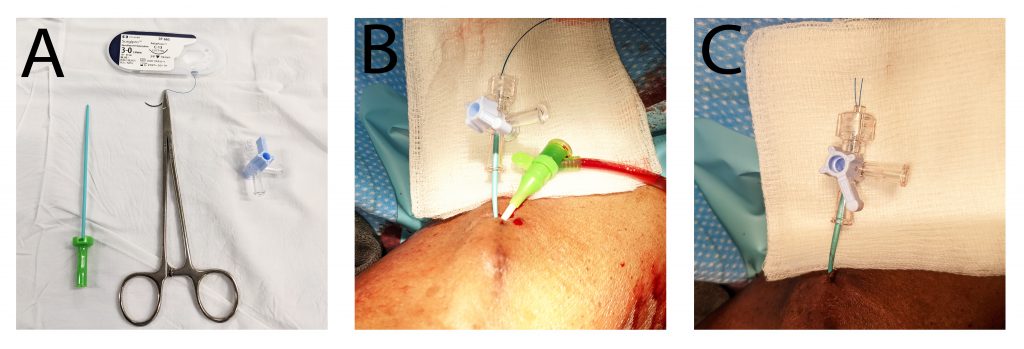
The Woggle technique utilizes a superficial purse string suture around the sheath entry site with its ends threaded through the cut tip of the sheath’s dilator, which serves as a tension collar. The sutures are then fed through a stop cock valve (or similar device), which provides the tightening and locking mechanisms for the system. This technique can be used in accesses with or without a skin nick.

The Woggle technique, if performed correctly, obviates the need to obtain manual hemostasis, which can be particularly helpful in patients on anticoagulation or who receive heparin during the procedure. This technique can also help prevent every fellow’s and junior staff’s nightmare scenario of thrombosing a circuit with aggressive manual compression.

Materials (Figure 1A):

  1. One suture. I use a 2-0 or 3-0 monofilament suture with a curved cutting needle.
  2. One sheath dilator tip, cut to approximately 3 cm (these can fly away while cutting, so I (or my assistant) to cut it under a sterile towel). A guide wire introducer can also be used.
  3. One stop cock (or equivalent).

Method (Figure 1B and 1C):

  1. Make a superficial purse string suture around the sheath. Be careful not to suture the sheath and/or access vessel. I will sometimes instill lidocaine to create a buffer if the vessel is immediately subdermal.
  2. Cut the needle off the suture and feed the two free ends through the tapered tip of the cut sheath dilator. Cut the suture flush, leaving around 10 – 15 cm of suture length.
  3. Once the free suture ends are fed through the dilator tip, feed the suture ends through the stopcock.
  4. Tell your assistant to stand out of the line of fire (blood squirting) and remove the sheath while tightening the sture by turning the stopcock dial. One-half turn will usually suffice, as the suture may fracture with aggressive turning.
  5. Leave in situ for 20 – 120 (our patients recover for two hours, so I write orders to D/C the Woggle just prior to discharge, as this length of time reduces risk of bleeding if the patient is anticoagulated).
  6. When D/Cing the Woggle, turn the dial in the opposite direction used for locking and carefully loosen the device by retracting the dilator tip (stiffening collar). If there is still evidence of arterial bleeding, one can re-initiate the tightening and locking mechanism. If there is no evidence of arterial bleeding, the suture may be removed. Soft manual compression may be required for a brief moment due to mild oozing from the suture removal.

Note: If someone else is disassembling the Woggle, education is important, so be sure they know how it works, why it works, and how to properly disassemble and assemble as required.

Figure: The Woggle. Equipment (A); Woggle created with sheath in situ (B); Woggle in action (C).

Figure: <strong>The Woggle</strong>. Equipment (A); Woggle created with sheath in situ (B); Woggle in action (C).


Reference:

Simons, Martin E., Dheeraj K. Rajan, and Timothy W. I. Clark. 2003. “The Woggle Technique for Suture Closure of Hemodialysis Access Catheterization Sites.” Journal of Vascular and Interventional Radiology: JVIR 14 (4): 485–88.

New interventional radiology suites allow medical experts to treat some diseases without major surgery.

The Canadian Association for Interventional Radiology (CAIR) will be holding a virtual Annual General Meeting (AGM) for its voting members in good standing on June 14th, 2021 at 7:00 pm EST.

The Canadian Association for Interventional Radiology (CAIR) will be holding a virtual Annual General Meeting (AGM) for its voting members in good standing on June 14th, 2021 at 7:00 pm EST.

CAIR Express - your Canadian Interventional Radiology newsletter at your fingertips. Feel free to pass it along to others in your network, and most importantly, enjoy the content that is developed with you in mind. 

The Department of Radiology at Niagara Health seeks a highly skilled and motivated fellowship trained Vascular and Interventional Radiologist with a track record for providing compassionate and efficient care to join the Diagnostic Imaging Service.

Interventional radiology is a field that offers boundless opportunities and part of what makes this specialty one of the most exciting fields in medicine is the fact that it is constantly evolving.

Tara Utley has over 20 years of experience in the medical imaging industry between the clinical environment as an Interventional Technologist (MRT), and delivering education through her more recent experiences in product management.

With the introduction of the Royal College (RC) Subspecialty exam in Interventional Radiology (IR), practicing IRs across Canada are faced with a decision: Do I really need to take another Royal College exam? 

This segment will feature a unique pearl learned by a junior VIR staff during residency or fellowship to share with our community.

Dr. Woodley-Cook has been practicing diagnostic and interventional radiology in Scarborough since 2015, where he has honed his practice to emphasize on hemodialysis interventions and peripheral vascular disease.

Dr. Joel Woodley-Cook

Dr. Woodley-Cook was raised in Hamilton, Ontario, where he finished his Master’s victory lap in endothelial cell biology at McMaster University. All the while, he had his sights on the dark stout and green hills of Dublin, Ireland, where he spent five unforgettable years completing his medical degree at University College Dublin. During this time in medical school, Joel’s initial surgical desires gradually shifted towards VIR following clinical observerships with Dr. Beecroft at JDMI and research electives with Dr. Amaral at Sick Kids.

Dr. Woodley-Cook matched to radiology at the University of Toronto while attending SIR in San Diego and the 3rd person he called in celebration was his friend from Hamilton, Dr. Tara Graham. His VIR fellowship was completed at JDMI alongside Dr. Sinclair, whose comradery provided much comfort in the trenches of UHN and Mt. Sinai.

Dr. Woodley-Cook has been practicing diagnostic and interventional radiology in Scarborough since 2015, where he has honed his practice to emphasize on hemodialysis interventions and peripheral vascular disease.

He enjoys cooking for his wife, two sons, and two cats and used to enjoy attending sporting events in Toronto and afar.

New interventional radiology suites allow medical experts to treat some diseases without major surgery.

The Canadian Association for Interventional Radiology (CAIR) will be holding a virtual Annual General Meeting (AGM) for its voting members in good standing on June 14th, 2021 at 7:00 pm EST.

The Canadian Association for Interventional Radiology (CAIR) will be holding a virtual Annual General Meeting (AGM) for its voting members in good standing on June 14th, 2021 at 7:00 pm EST.

CAIR Express - your Canadian Interventional Radiology newsletter at your fingertips. Feel free to pass it along to others in your network, and most importantly, enjoy the content that is developed with you in mind. 

The Department of Radiology at Niagara Health seeks a highly skilled and motivated fellowship trained Vascular and Interventional Radiologist with a track record for providing compassionate and efficient care to join the Diagnostic Imaging Service.

Interventional radiology is a field that offers boundless opportunities and part of what makes this specialty one of the most exciting fields in medicine is the fact that it is constantly evolving.

Tara Utley has over 20 years of experience in the medical imaging industry between the clinical environment as an Interventional Technologist (MRT), and delivering education through her more recent experiences in product management.

With the introduction of the Royal College (RC) Subspecialty exam in Interventional Radiology (IR), practicing IRs across Canada are faced with a decision: Do I really need to take another Royal College exam? 

This segment will feature a unique pearl learned by a junior VIR staff during residency or fellowship to share with our community.

Dr. Woodley-Cook has been practicing diagnostic and interventional radiology in Scarborough since 2015, where he has honed his practice to emphasize on hemodialysis interventions and peripheral vascular disease.