Access Menu
Call for CAIR Award 2025 Nominations
Annual General Meeting Notice 2025
Interventional Radiologist | Niagara Health
CAIR WIR Spotlight - Dr. Ethel Rivas Zuleta
CAIR WIR Spotlight - Dr. Rebecca Spouge
CAIR WIR Spotlight - Dr. Elizabeth Dave
CAIR WIR Spotlight - Dr. Aida Ahrari
CAIR WIR Spotlight - Dr. Fiona Anyumba
This segment will feature a unique pearl learned by a junior VIR staff during residency or fellowship to share with our community. This pearl is written by Dr. Joel Woodley-Cook from Scarborough Health Network.
Exchanging the blocked catheter (usually a gastrojejunostomy). The pull, cut and push technique.
It’s 3 PM on a Friday before a long weekend and the internist calls and says, “I think this patient’s GJ tube is blocked. The nurse keeps trying, but the semi-crushed tablet-apple sauce paste won’t go through. I need a stat change before this patient can go back to their nursing home. And they need to go back today or they will lose their bed at the nursing home and it will be all your fault”.
This exchange procedure typically goes smoothly but can go downhill quickly without a well established tract to re-enter. The technique described below is my go-to for a blocked catheter (usually GJ but sometimes nephrostomy).
I learned this technique from Dr. Martin Simons during my last month as a resident. This “pull, cut and push” technique is one I use often and is performed under fluoro (I sometimes bypass Step 1, but Step 1 does provide improved trackability of the catheter). This example will focus on a blocked GJ exchange:
- Insert a 0.035” Amplatz through the hub or cut sidehole as far as it will go (obviously if it finds a sidehole, the procedure is likely nearly over and you can ignore steps 2+).
- Retract the catheter under fluoro such that the pigtail lies within the 2nd segment of the duodenum.
- Cut a side-hole close to the skin that is large enough to fit the tip of a second Amplatz but small enough such that the tip does not easily pop out. I usually insert the tip approximately 1 – 2 cm.
- Advance the catheter under fluoro until the side hole is in the 2nd – 3rd segment of the duodenum.
- Retract the tip of the wire that is in the side hole and voila, you have wire access into the duodenum.
- Carefully remove the catheter under fluoro after releasing the pigtail as you normally would (don’t pull out your new exchange wire) and proceed with the exchange.
This segment will feature a unique pearl learned by a junior VIR staff during residency or fellowship to share with our community. This pearl is written by Dr. Joel Woodley-Cook from Scarborough Health Network.
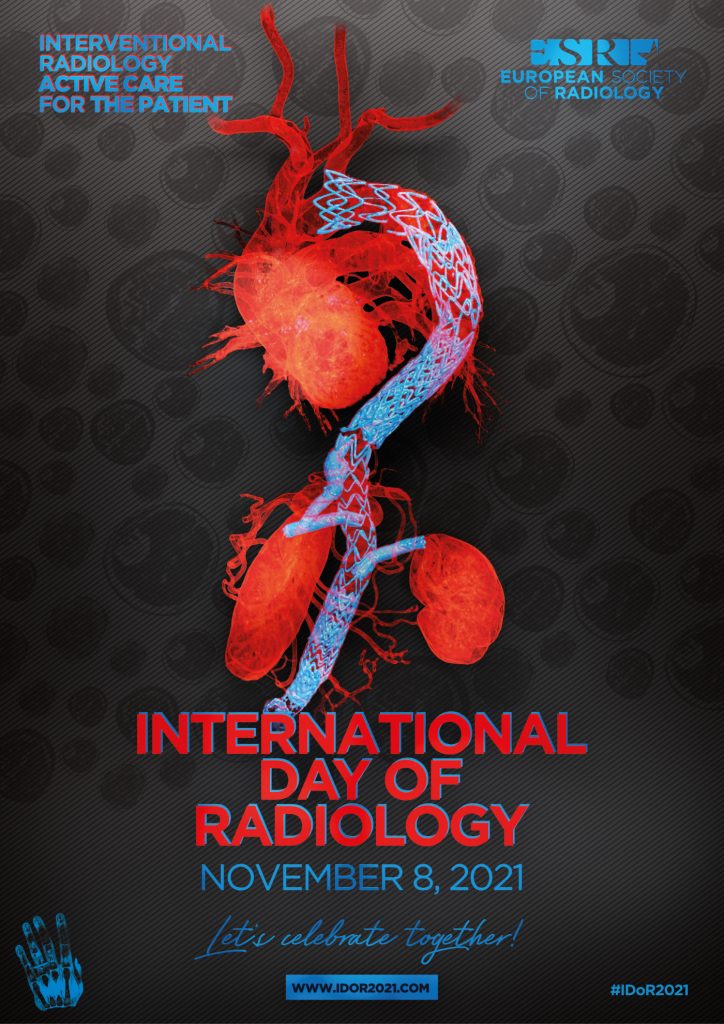
In 2021, the International Day of Radiology is dedicated to Interventional Radiology and its essential role in treating patients.
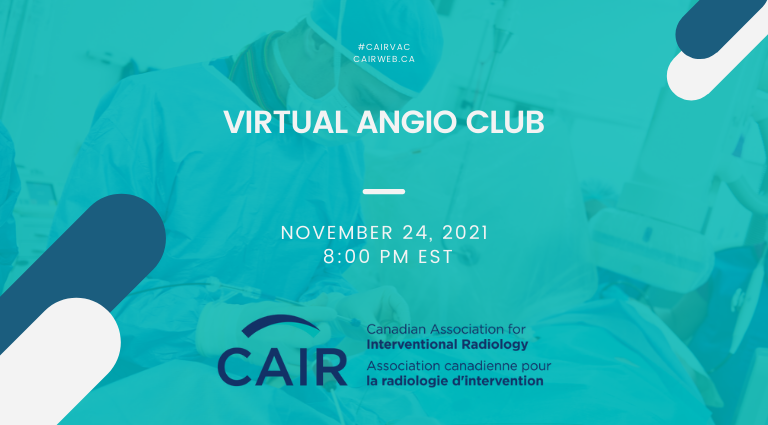
Do you have a great case to present? Our next Virtual Angio Club (VAC) is now accepting submissions!
September 30, 2021 marks the first ever National Day for Truth and Reconciliation in which we honour the lost and missing children of residential schools, the families left behind, and the survivors.
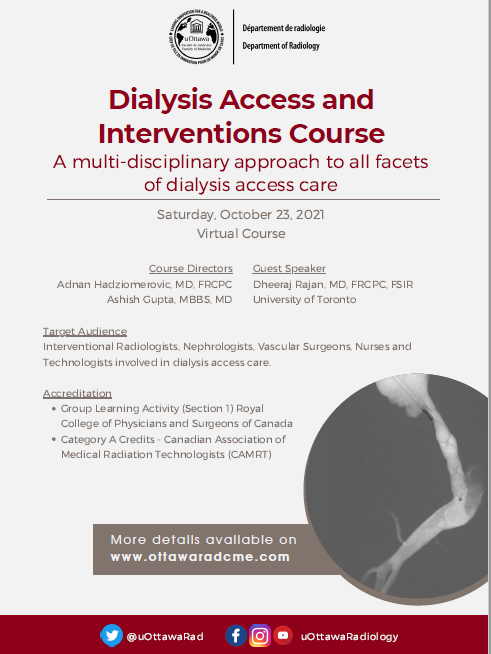
The purpose of this one-day weekend virtual CME course is to offer attendees a comprehensive understanding of dialysis access creation and maintenance.
A draft presentation of no more than 8-10minutes should be submitted by September 26, 2021 via email at cairservice@cair.sociationdev.com
Alberta Health Services says a woman considered dead for 30 minutes was brought back to life by doctors using a new device for what's believed to have been the first time in Canada.
CAIR Express - your Canadian Interventional Radiology newsletter at your fingertips. Feel free to pass it along to others in your network, and most importantly, enjoy the content that is developed with you in mind.
Dr. Tara Graham is the current Chief of Vascular and Interventional Radiology at Trillium Health Partners and Lecturer at the University of Toronto, Faculty of Medicine. She completed her Interventional Radiology training at University Health Network in Toronto in 2013 and has served on the CAIR board since 2014. Her practice includes Interventional Oncology, peripheral vascular disease and aortic interventions. She is the current President of CAIR and Scientific Director of the CAIR meeting.
 The
The