
Access Menu
Call for CAIR Award 2025 Nominations
Annual General Meeting Notice 2025
Interventional Radiologist | Niagara Health
CAIR WIR Spotlight - Dr. Ethel Rivas Zuleta
CAIR WIR Spotlight - Dr. Rebecca Spouge
CAIR WIR Spotlight - Dr. Elizabeth Dave
CAIR WIR Spotlight - Dr. Aida Ahrari
CAIR WIR Spotlight - Dr. Fiona Anyumba

Image-guided pain management is kind of the elephant in the room with many VIRs in Canada – we don’t do a lot of this, as they are typically performed by anesthesiologists, surgeons in subspecialties, or MSK-imaging trained diagnostic radiologists. During fellowship, the only image-guided pain control procedures Coco and I recalled performing were celiac plexus ethanol ablations and observing the odd vertebroplasty through a leaded glass window. As VIR staff, we have come to realise that a majority of our chronic vascular and haemodialysis patients (over 50%) have had some form of image-guided interventions (most commonly cervical/lumbar facets and large joint injections) performed by non-radiology specialists. We decided to dig deeper into the world of image-guided pain management and came across nerve ablation for large joint pain (typically fracture or OA) in non-operative patients. We discovered an interventional radiologist in Atlanta, Georgia, Dr. Prologo, and decided to pick his brain about nerve ablation.
J. David Prologo, MD, is Associate Professor in the Department of Radiology at Emory University School of Medicine and Director of Interventional Radiology Services at Emory Johns Creek Hospital. Dr. Prologo is an interventional radiologist specializing in diagnostic radiology, interventional radiology, obesity medicine, interventional pain management and bone tumor ablations.
Dr. Prologo received his MD from Ohio State University and completed radiology residency at University Hospitals Case Medical Center in Cleveland, Ohio. He then completed a fellowship in vascular and interventional radiology at Metrohealth Medical Center in Cleveland, Ohio.
Dr. Prologo’s research has focused on the application of image guided techniques to the delivery of stem cell therapies, the treatment of cancer pain, and for obesity management. He is a recognized expert in ablative therapies and has pioneered several new procedures in the subspecialty including the cryoablation of nerves.
When we first learned about genicular nerve ablation, we thought to ourselves – how? RFA? Microwave? Cryo? Ethanol? Could you briefly describe your experience with this procedure and how you have seen it evolve in recent years?
The original fluoroscopically guided RFA procedure was largely driven by industry. Companies with RFA probes marketed to the public and then trained the interventionalists. Over time, research demonstrated quite a bit of variability in the nerve courses and suggested that we were missing a good amount of the time. As a result, we (IR) began (as we always do LOL) to improve on this by using ultrasound (better guidance) and/or cryo (larger ablation zones).
Other than using an (RFA) probe, would you consider other methods to be safe? For example, could etOH ablation be feasible or would damage to muscular branches be too risky?
Alcohol in my opinion is too expensive and impossible to control in this setting. Cryoablation is less painful, more predictable, and covers more space – making it ideal.
Could this procedure be performed solely under US guidance?
Yes.
How are you referred patients?
Primarily from ortho in patients who don’t qualify or don’t want knee replacement.
How do you select patients?
Painful osteoarthritic knee or failed knee replacement without contraindication.
How do you follow these patients?
At 3, 6, and 12 months. Usually between 12 and 18 months we will repeat.
How many treatments are typically required?
One treatment lasts 12-18 months. The best outcome would be if the patient used that window to exercise, lose weight, and get the TKR.
What is the most common complication you see?
Complications are quite rare.
How does this compare to genicular artery embolization (GAE)?
Interesting question. GAE does attempt to attenuate the pathophysiology of the disease while (genicular nerve ablation) is purely pain relief. That said, GAE is a little more involved and risky.
How many times do people refer to genicular nerve ablation as geniculate nerve ablation?
They generally refer to IR. We then decide which procedure to perform.
How can an established VIR get trained in this procedure?
These patients are out there. I recommend primarily going straight to them by pitching a news story, engaging a media liaison, or straight marketing. Alternatively, one could educate the orthopaedic surgeons (as above) and/or primary care doctors about these non-surgical options. Last, I would try to provide as quick a service as possible for the referrers.
Select references:
Is Genicular Nerve Radiofrequency Ablation Safe? A Literature Review and Anatomical Study
Can cooled RF ablation relieve post-knee replacement pain?
Cooled Radiofrequency Ablation May Relieve Chronic Pain after TKA
Image-guided pain management is kind of the elephant in the room with many VIRs in Canada - we don’t do a lot of this, as they are typically performed by anesthesiologists, surgeons in subspecialties, or MSK-imaging trained diagnostic radiologists.
The Department of Radiology, McMaster University and the Department of Diagnostic Imaging, Hamilton Health Sciences are seeking a full-time radiologist for the Juravinski Hospital and Cancer Centre interventional program, for start date of July 2023.
CAIR Express - your Canadian Interventional Radiology newsletter at your fingertips. Feel free to pass it along to others in your network, and most importantly, enjoy the content that is developed with you in mind.
Dr. Virani grew up in the Greater Toronto Area and pursued undergraduate and graduate studies at Western University. He returned to Toronto for medical school before venturing out east for Diagnostic Radiology residency at Dalhousie University in Halifax.
Dr. Supersad is currently a PGY-4 resident in diagnostic radiology at the University of Alberta. She was born and raised in Edmonton, and after medical school at the University of Calgary is back in her hometown to complete residency.
After growing up and completing medical as well as radiology training in Cape Town, South Africa (population approximately 5 million), Dr. Stefan Przybojewski, felt it was getting a bit small and was looking for adventure.
Through education, mentorship, and conversation this five-year program is on course to empower existing and future Women in Interventional Radiology.
Dr. Gilles Soulez MD, MSc, FSIR is a vascular and interventional radiologist at CHUM, University of Montréal. He completed his radiology residency in France at University Paris V in 1988 and completed a 2-year fellowship combined with a certification of the French College of Interventional Radiology.
Dr. Lindsay Machan is an interventional radiologist at the Vancouver Hospital, a CIRSE Distinguished Fellow, SIR Fellow and an Asia Pacific Society of Interventional Radiology Honorary Member
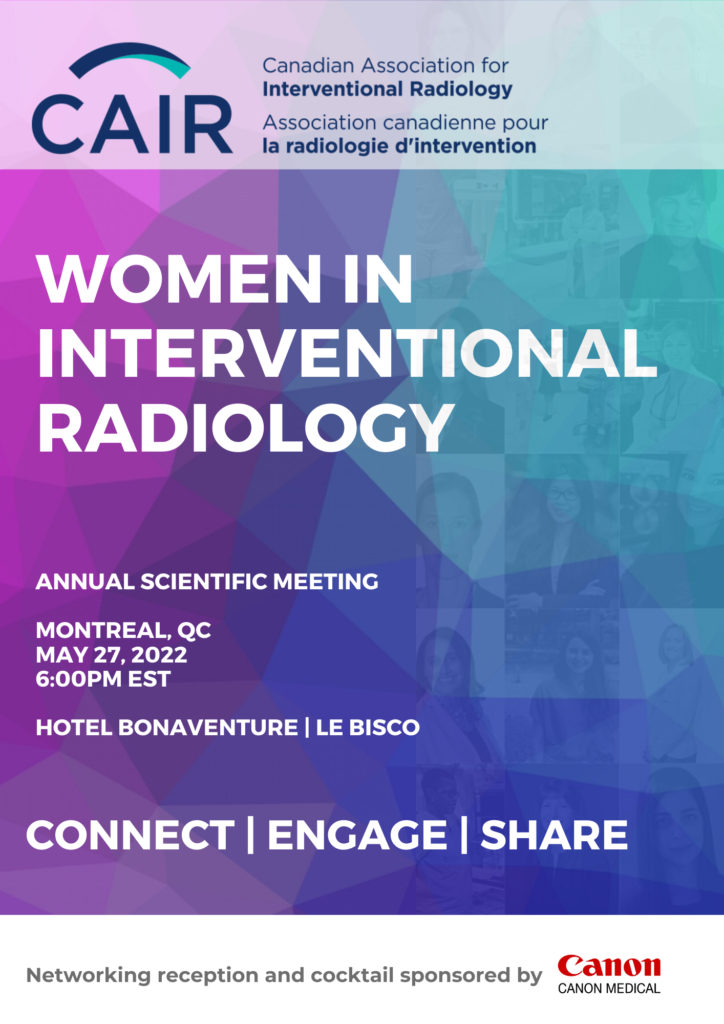
The Canadian Association for Interventional Radiology (CAIR) will be holding an in-person Annual General Meeting (AGM) for its voting members in good standing on May 27th, 2021 at 15:30 pm EST at Hotel Bonaventure in Montreal, during CAIR's Annual Scientific Meeting.